
Body piercing is often seen as a modern rebellious statement, but in reality, it is one of humanity’s oldest forms of self-expression. From the golden plugs of Egyptian Pharaohs to the intricate septum rings of Aztec warriors, the jewelry we wear today is a bridge to our ancestral past.
Today, we’re taking a journey through time to see how body piercing jewelry has evolved from ancient rituals to the high-tech, bio-compatible masterpieces of the 21st century.
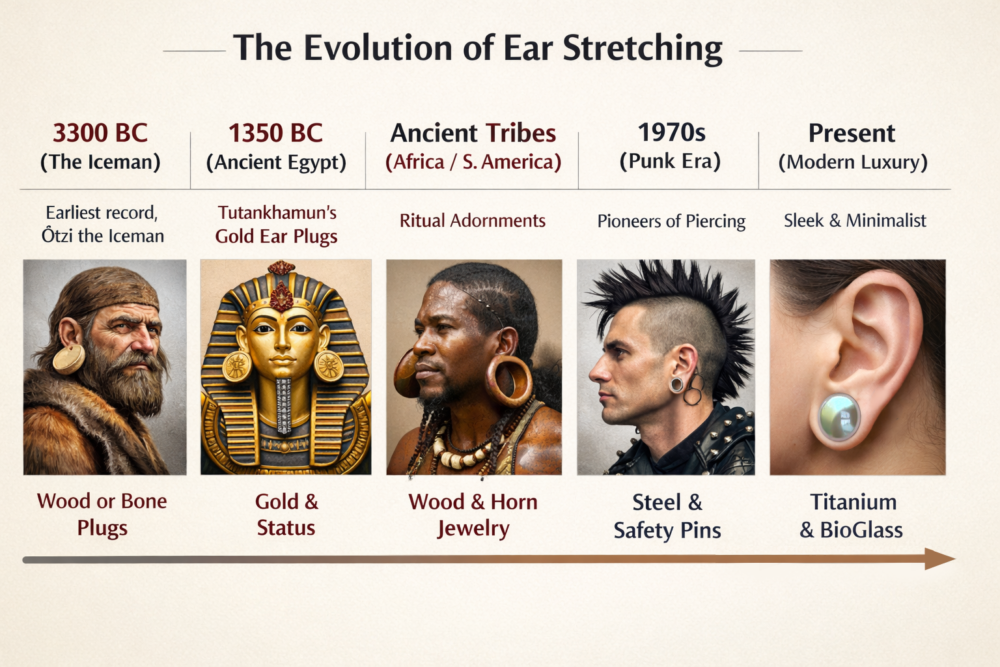
1. Ancient Origins: Power, Status, and Protection
In ancient civilizations, piercing was rarely just about “looking good.” It was a map of a person’s life, status, and bravery.
- Ancient Egypt: Ear piercing was a sign of wealth and royalty. King Tutankhamun’s death mask even features earlobe holes, and historical records show that Pharaohs favored heavy gold hoops and lapis lazuli inlays.
- The Roman Empire: Roman centurions were known to pierce their nipples as a symbol of virility and companionship, as well as a practical way to keep their capes pinned to their tunics.
- Mayan and Aztec Cultures: Tongue and septum piercings were used in religious rituals to communicate with the gods. These were often adorned with jade, obsidian, and gold.
2. The Cultural Roots of Stretching (Ear Gauges)
The “stretching” community today owes much to the indigenous tribes of Africa, South America, and Southeast Asia.
- The Maasai Tribe: For the Maasai people of Kenya, stretched lobes adorned with colorful beadwork and carved wood signify age and wisdom.
- King Tut & Siddhartha: Both the Egyptian boy-king and Gautama Buddha are historically depicted with stretched lobes—symbols of the heavy, precious jewelry they wore during their lives of royalty.
- Materials of Old: Before the invention of surgical steel, our ancestors used Bone, Horn, Wood, and Stone—the same “organics” we celebrate in our Organic Collection today.
3. The Punk Revolution and Modern Subcultures
For centuries in the West, piercing (aside from women’s earlobes) fell out of fashion. That changed in the 1970s with the Punk Rock movement.
What began as a DIY “safety pin” aesthetic evolved into a professional industry in the late 70s and 80s, thanks to pioneers like Jim Ward and Gauntlet (the first professional piercing studio). This era introduced the Barbell and the Captive Bead Ring, which remain staples of the industry today.
4. Today’s Trends: The “Curated Ear” and Bio-Tech
Fast forward to the 2020s, and body piercing has entered the mainstream “Fine Jewelry” world.
- The Curated Ear: Instead of a single piercing, people now design complex “constellations” of jewelry across the cartilage, using dainty gold hoops and tiny titanium studs.
- Material Science: We have moved beyond simple metals. Today, we prioritize Implant-Grade Titanium and Niobium, materials designed to be ignored by the human immune system, allowing for faster healing and zero irritation.
- Sustainability: Modern enthusiasts are returning to Sustainability, choosing ethically sourced wood and hand-polished stones that respect the earth while honoring ancient traditions.
The Future of Piercing
Body jewelry continues to evolve. We are seeing a move toward “minimalist luxury”—high-end materials used in subtle, elegant ways. Whether you are wearing a Traditional Wood Plug or a Ear Care, you are participating in a 5,000-year-old human tradition.
What’s your story? Every piercing is a new chapter.